 It's free, continue with Google
Generative engine optimisation (GEO): a practical guide for marketing teams
Generative engine optimisation is the work of getting your business named and cited in AI answers. Most of it is good SEO done properly, plus early answers, sourced facts and off-site mentions.
 By
The short answer
GEO is not a new discipline that replaces search. It is search, written for a reader that quotes. Google's own documentation says "there are no additional requirements to appear in AI Overviews or AI Mode, nor other special optimizations necessary" (Google Search Central). What has changed is which pages get picked. In Surfer's June 2026 study of 100,000 citations, 38% of AI Overview citations came from a page's first 100 words, up from 20% in 2025. If your answer sits in paragraph six, it is invisible to the machine that now answers first.
This guide covers what GEO is, what Google says, how engines choose sources, which crawlers to allow, and how to measure any of it honestly. Related guides are collected under AI search and visibility.
What is generative engine optimisation, and how is it different from SEO and AEO?
Generative engine optimisation is the practice of shaping your content and your wider web presence so that AI systems that write answers, rather than list links, name and cite your business. SEO earns a ranked link. AEO earns a direct answer or snippet. GEO earns a mention inside a generated response. The three overlap heavily.
The term comes from a 2023 Princeton-led paper, published at KDD 2024, that coined "generative engine optimization" and built a benchmark to test it (Aggarwal et al.). Australian and British writers spell it "optimisation"; the discipline is the same.
| SEO | AEO | GEO | |
|---|---|---|---|
| What you win | A ranked blue link | A direct answer, snippet or voice answer | A mention or citation inside an AI-written answer |
| Where it shows | Google and Bing results | Featured snippets, People Also Ask, assistants | ChatGPT, Perplexity, Gemini, Copilot, AI Overviews, AI Mode |
| Unit of competition | The page | The answer passage | The passage, plus your brand's reputation across the web |
| Main levers | Relevance, links, technical health | Question headings, concise answers | Everything in SEO and AEO, plus early answers, sourced facts and off-site mentions |
| How you measure | Rankings, clicks, conversions | Snippet ownership | Mentions, citations, AI referral visits, conversions |
| Does it need special markup | No | No | No, according to Google |
Source: PostCliq analysis of Google Search Central and Aggarwal et al., KDD 2024
Does Google say you need to optimise for AI separately?
No. Google says a page must be indexed and eligible to show with a snippet, and nothing more, to appear as a supporting link in AI Overviews or AI Mode. Its July 2026 AI optimisation guide says llms.txt, chunking and AI-specific rewrites neither help nor harm. Normal SEO decides whether you are in the running.
That matters commercially, because a lot of "AI optimisation" is being sold as a separate retainer. Google's guide to optimising for generative AI features (updated 10 July 2026) pushes the same things it always has: unique, non-commodity content, first-hand expertise, clear headings, good page experience and semantic HTML. The controls are the ordinary ones too. nosnippet, data-nosnippet, max-snippet and noindex limit AI features exactly as they limit snippets. Google-Extended governs Gemini training and grounding, and does not change inclusion or ranking in Google Search (Google common crawlers).
This is not only a United States question. Google launched AI Mode in Australia in English on 8 October 2025 (Google Australia). Our longer read on the traffic side is in what AI Overviews do to your search traffic.
How do AI engines decide what to cite?
AI engines split a question into several related searches, retrieve passages from the results, and cite the pages whose passages answer a sub-question most directly. Being on page one for the original query is no longer enough. Pages that answer early, cover the sub-questions, and carry sourced facts are cited more often.
Query fan-out: why the top 10 is not enough
Google confirms that AI Overviews and AI Mode issue multiple related searches to build one answer (Google Search Central). This is called query fan-out, and it changes who wins. Ahrefs found that only 38% of AI Overview citations came from pages in the top 10 for the original query in March 2026, and attributes the change to fan-out. Across ChatGPT, Gemini and Copilot, only about 12% of cited URLs ranked in Google's top 10 for the prompt, in a study of 15,000 long-tail queries (Perplexity reached 28.6%).
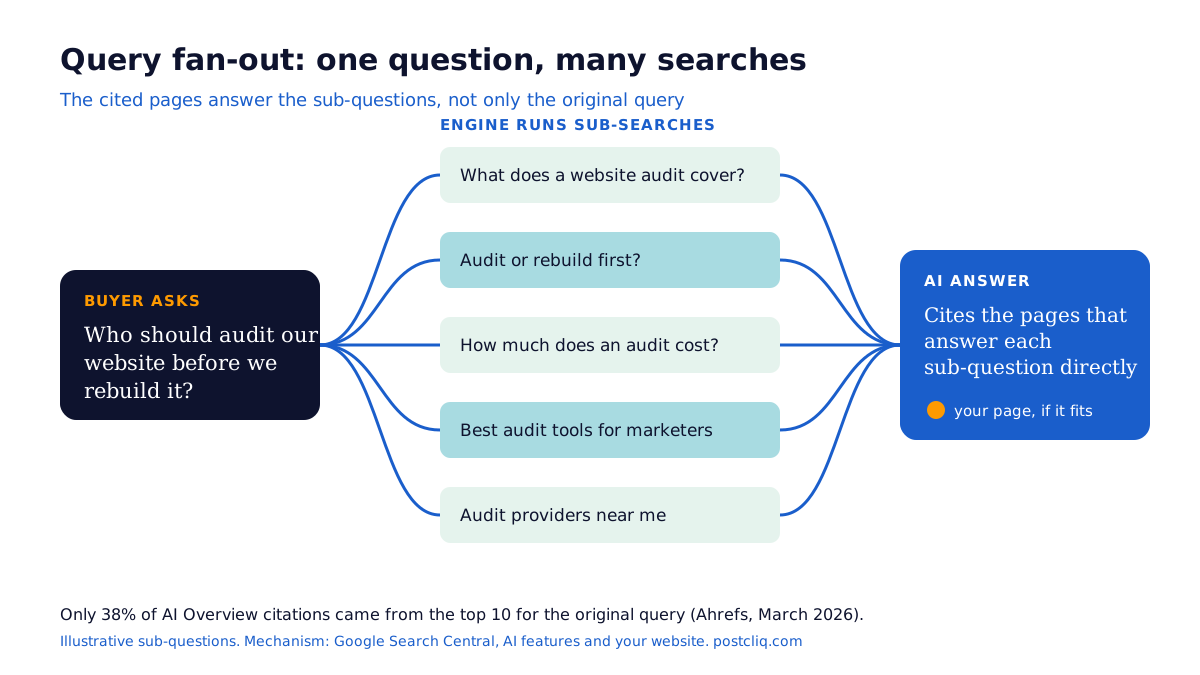
The practical fix is a cluster, not a keyword. A pillar page answers the broad question and links to spokes that each answer one sub-question well. This guide and our companion guides on getting cited by ChatGPT and checking your AI visibility are built that way on purpose.
The opening does most of the work
Two datasets point the same way. Surfer found 38% of AI Overview citations come from the first 100 words, and pages that confirm the query early were cited 45% of the time against 23% for pages that do not (Surfer, June 2026, vendor study). Microsoft's own guidance for AI search tells publishers to use question-style headings, short self-contained answers, lists and tables, and warns against key facts hidden in tabs, PDFs or images (Microsoft Advertising, October 2025).
Statistics, quotations and sources lift visibility
The original GEO paper tested nine content methods on a simulated generative engine. Adding quotations, statistics and citations to sources beat the baseline clearly. Keyword stuffing did worse than doing nothing.
| Method | Visibility score | Against baseline of 19.5 |
|---|---|---|
| Quotation addition | 27.8 | +43% |
| Statistics addition | 25.9 | +33% |
| Fluency optimisation | 25.1 | +29% |
| Cite sources | 24.9 | +28% |
| Keyword stuffing | 17.8 | -9% |
Source: Aggarwal et al., GEO: Generative Engine Optimization, KDD 2024
The percentage column is our arithmetic on the paper's scores (27.8 divided by 19.5 is 1.43). Treat the result as directional. It is a lab benchmark, not a production ranking model, and the gains were largest for lower-ranked sources.
Where does each AI engine pull its sources from?
Each engine leans on different sources. In US AI Overviews, YouTube and Reddit lead. ChatGPT leaned on Wikipedia in 2025. Perplexity leans on Reddit. So a GEO plan that only edits your own website misses most of where answers are sourced, and one plan will not fit every engine.
Read that chart carefully. Each figure is a domain's share of all citations earned by the 50 most-cited sources, not a share of every AI Overview. It is US data and a vendor dataset. It still makes the point: the most-cited places are platforms where other people talk about you.
The picture differs by engine. Profound's analysis of 680 million citations found Wikipedia was ChatGPT's top source at 7.8% of citations, Reddit led Perplexity at 6.6%, and AI Overviews spread citations across Reddit, YouTube, Quora and LinkedIn (Profound, June 2025, vendor study, August 2024 to June 2025 data). Engines also change their habits quickly, which is why a single snapshot is weak evidence.
Which AI crawlers should you allow in robots.txt?
Allow the search and retrieval bots if you want to be cited, and decide on the training bots as a separate business choice. Each AI company now runs separate crawlers for training and for search. Blocking a training bot does not remove you from that company's search answers. Blocking a search bot does.
| Company | User-agent token | What it is for | If you block it |
|---|---|---|---|
| OpenAI | OAI-SearchBot | ChatGPT search index | Not shown in ChatGPT search answers |
| OpenAI | GPTBot | Model training | Excluded from training, no effect on ChatGPT search |
| OpenAI | ChatGPT-User | Fetches a page when a user asks | Limited effect, user-initiated |
| Anthropic | Claude-SearchBot | Search quality for Claude | Lower visibility in Claude's search answers |
| Anthropic | ClaudeBot | Model training | Excluded from future training |
| Perplexity | PerplexityBot | Perplexity search index, not training | Not surfaced in Perplexity |
| Googlebot | Google Search, including AI Overviews and AI Mode | Out of Google entirely | |
| Google-Extended | Gemini training and grounding | No effect on Google Search inclusion or ranking | |
| Microsoft | bingbot | Bing index, which feeds Copilot | Out of Bing and Copilot |
Source: OpenAI crawlers , Anthropic crawlers, Perplexity crawlers, Google common crawlers
OpenAI notes it can take about 24 hours after a robots.txt change for its search systems to adjust (OpenAI). The bigger trap sits in front of robots.txt. Cloudflare announced default blocking of AI crawlers on 1 July 2025 (Cloudflare), and from 15 September 2026 it blocks training and agent bots by default on ad-monetised pages while leaving search bots allowed (Cloudflare). Multi-purpose crawlers can be caught by the strictest rule. Check your CDN and firewall settings alongside robots.txt, because a site can be invisible to an answer engine without anyone having decided that.
Do off-site mentions matter more than backlinks for AI visibility?
Yes, on the best available evidence. Across 75,000 brands, mentions on YouTube and branded mentions across the web correlated with AI visibility at roughly 0.66 to 0.74. Backlink counts correlated at about 0.2 to 0.3. Correlation is not cause, but the gap is wide enough to change where effort goes.
| Signal | ChatGPT | Google AI Mode | Google AI Overviews |
|---|---|---|---|
| YouTube mentions | 0.737 | 0.740 | 0.712 |
| Branded web mentions | 0.664 | 0.709 | 0.656 |
| Branded anchors | 0.511 | 0.628 | 0.527 |
| Branded search volume | 0.352 | 0.466 | 0.392 |
| Domain Rating | 0.266 | 0.285 | 0.326 |
Source: Ahrefs, AI brand visibility correlations, December 2025
Ahrefs sells a product that tracks these signals, so treat it as a vendor study. The direction matches the domain data above. Answer engines repeat what the web says about you, and the web is mostly other people's sites. For a B2B marketing team that means founder posts on LinkedIn, short YouTube explainers, genuine participation in the forums your buyers use, review-site listings, podcasts and partner pages. Google warns that "inauthentic mentions" do not work as well as quality content (Google), so earn them rather than buy them.
How do you measure generative engine optimisation?
Measure four things: whether assistants mention you for real buyer questions, which of your pages they cite, how many visits arrive from AI sources, and whether those visits become enquiries. No single tool reports all four, and none reports a trustworthy "share of AI traffic lost". Build a small, repeatable panel instead.
The instruments available today are narrower than most vendors imply:
- Google Search Console folds clicks from AI Overviews and AI Mode into ordinary Web search results (Google). Its generative AI performance report shows impressions only, with no clicks or prompts (Search Console Help).
- Bing Webmaster Tools AI Performance (public preview since 10 February 2026) shows citations, cited pages and grounding queries across Microsoft Copilot, AI summaries in Bing and some partners (Bing Webmaster Blog).
- GA4 referrals from chatgpt.com, perplexity.ai and similar hosts give you a floor, not a total, because some assistants open links without a referrer.
- A fixed prompt panel: the same buyer questions, asked the same way, on the same assistants, every month. Our guide on how to check your AI visibility sets out the protocol, and the ten buyer questions resource gives you the questions and a scoring sheet.
A worked example: is AI traffic worth chasing yet?
Volume is small and quality is high, so do the arithmetic before you commit budget. Ruler Analytics found AI referral traffic converted at 5.8% in 2026, against 4.9% for organic search, across more than 110 million sessions in its mostly UK lead-generation customer base (Ruler Analytics).
Take an illustrative site with 12,000 organic sessions a month and 240 AI referral sessions (2% of organic). At those rates, organic produces 12,000 x 4.9% = 588 conversions and AI produces 240 x 5.8% = about 14. AI traffic converts about 18% better (5.8 divided by 4.9 is 1.18), and still delivers about 2% of the conversions. Double AI referrals and you add about 14 conversions a month. Lift the organic conversion rate from 4.9% to 5.4% and you add 60.
The figures are invented for the example. The lesson is not: GEO is worth doing because the channel is growing and the visitors arrive with intent, but for most sites today the larger lever is still what happens after the click. That argument is set out in every click is worth more than it used to be.
How does PostCliq check AI readiness today?
PostCliq's free audit includes an AI readiness category that checks what is on your public pages. It does not ask assistants about you, track citations or estimate AI traffic. It looks at whether a machine can read your pages, which crawlers you allow, and whether your claims carry visible sources.
Specifically, on up to 50 public pages it checks three things:
- Extractability and entity clarity. Whether page text is present in the raw HTML without JavaScript, whether JSON-LD structured data parses, and whether the homepage names the organisation in structured data.
- AI crawler policy. robots.txt is evaluated for each named AI agent, including GPTBot, OAI-SearchBot, ChatGPT-User, ClaudeBot, PerplexityBot and Google-Extended. A block is shown as a policy choice, never scored as a defect, because it can be deliberate.
- Evidence-backed claims. Whether numeric and award claims on your pages sit near a visible source.
What it does not do matters as much. It does not run a prompt panel, it cannot see your Cloudflare dashboard, and "AI readiness" is a rubric for your own pages, not a measure of market-wide visibility. The scope is written up on the AI search visibility page and in our audit methodology.
What to do next
- Check the basics first. Confirm your important pages are indexed in Google and Bing, snippet-eligible, and readable without JavaScript.
- Audit crawler access. Read your robots.txt against the table above, then check your CDN or firewall bot settings. Allow the search bots you want to be cited by.
- Rewrite the first 100 words of your ten most valuable pages so sentence one names the topic and the opening answers the question.
- Build one cluster. Pick the buyer question that matters most, map five to eight sub-questions, and give each a heading with a direct 40 to 60 word answer.
- Add sourced numbers and one named quote to each key page. Link the primary source.
- Earn mentions off-site. One LinkedIn post and one short video per flagship piece, a review-site listing and one partner page this quarter.
- Set a baseline. Run the ten buyer questions check now and again in 30 days, the same way.
- Run a free PostCliq audit to see the AI readiness checks on your own pages alongside what stops visitors becoming enquiries.
Frequently asked questions
Is GEO replacing SEO?
No. GEO sits on top of SEO rather than replacing it. Google says a page needs to be indexed and snippet-eligible to appear in AI Overviews, which is an SEO outcome, and pages that rank for related sub-queries are cited more often. What GEO adds is emphasis on early answers, sourced facts and off-site brand mentions, which classic SEO often treated as optional.
What is the difference between AEO and GEO?
Answer engine optimisation grew out of featured snippets and voice search, and focuses on owning the direct answer to a question. Generative engine optimisation focuses on being mentioned and cited inside answers that a language model writes. In practice the tactics overlap heavily: question headings, concise answers and clear entities help both. GEO puts more weight on reputation across other sites.
Do I need an llms.txt file for GEO?
It is optional. Google says llms.txt will neither harm nor help visibility in its AI features, and no major answer engine has confirmed it uses the file to choose citations. It takes about half an hour to create and passes an experimental Lighthouse check, so there is little downside. Just do not expect ranking or citation gains from it.
Does structured data help AI search?
Google says structured data is not required for its generative AI features and does not change rankings directly. It still helps search engines understand who you are, and Article, Organization and Breadcrumb markup remain supported for rich results. Mark up only what is visible on the page, make sure it parses, and do not expect special AI schema to guarantee a citation.
Do I need extra budget for GEO?
Usually not a separate line. Most GEO work is content and SEO work done in a different order: answer first, cover sub-questions, cite sources. The genuinely new spend is off-site, such as video, LinkedIn, review sites and PR, because mentions correlate with AI visibility. Fund that from existing content budget before paying for a separate AI retainer.
How long does GEO take to work?
There is no reliable benchmark. Crawler changes can take effect in about a day for OpenAI's search systems, while new content depends on indexing and on how often engines refresh. AI-cited pages skew fresher than organic results in Ahrefs' 2025 study. Run a fixed prompt panel monthly and judge the trend over three months rather than week to week.
Can a small Australian business compete with big brands in AI answers?
Often, yes, on specific questions. Low-authority sites already appear in AI Overview citations for niche queries, and buyer questions that include a location or a narrow service are less contested. Being specific about what you do, where, and for whom, and being mentioned on local directories, partner sites and industry forums, gives an assistant something concrete to repeat.
Can machines read your site?
Check it free.
PostCliq audits your public pages for AI readiness alongside what stops visitors becoming enquiries.
Free. No credit card.